
The newly released GPT-5 boasts far more powerful performance than previous models.
However, no matter how advanced an AI is, the quality of its output can be night and day depending on how we ask our questions.
If you want to move beyond simple answers and get in-depth, high-quality results as if they were written by an expert in the field, remember the following five prompt strategies. They will be your secret weapon to dramatically improve your ability to use GPT-5.
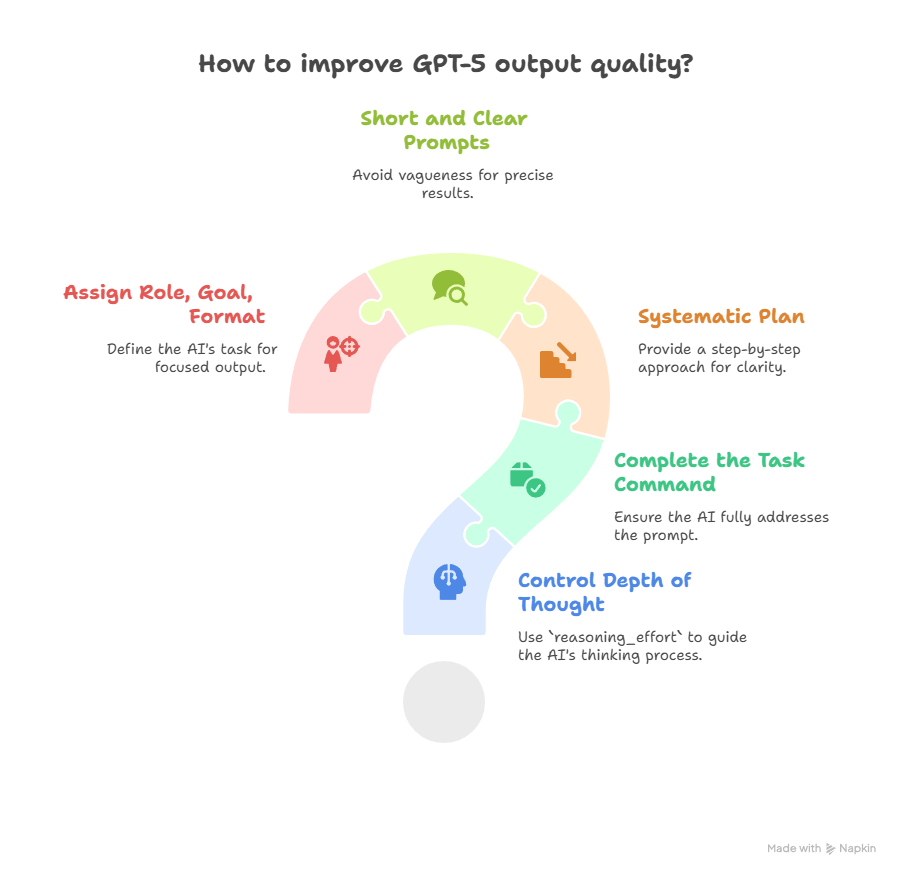
- Control the Depth of Thought.
- Give the “Comlete the Task” Command
- Present a Systematic ‘Step-by-Step Plan’
- Be Short and Clear, Not Long and Vague
- Assign a Clear ‘Role, Goal, and Format’
By using the five strategies above, you will be able to work with GPT-5 at a much higher level of capability.
1. Control the Deapth of Thought
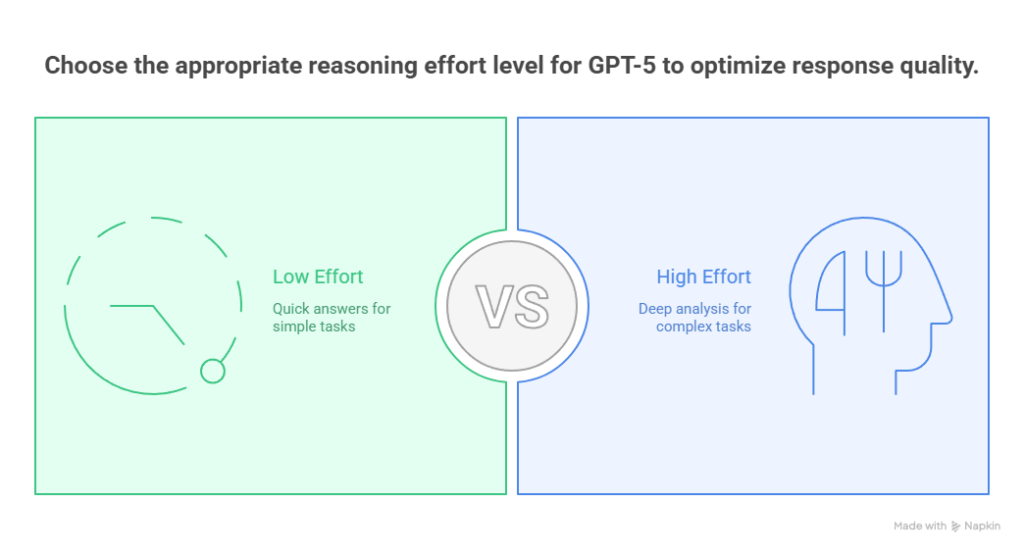
GPT-5 is said to have a feature called reasoning_effort , which detemines how deeply it thinks before generating a response. Simply adjusting this valus can change the quality of your results.
When set to low: This is useful when you need quick answers, such as for simple information retrieval or summarizing a long article.
- Examples: “Summarize this news article in three sentences,” or “Translate this sentence.”
When set to high: Use this when you need logical development and in-depth analysis, like in a market analysis report or a business proposal. GPT-5 will produce much more multifaceted and profound results.
- Example: “Analyze the attached market data and logically explain the key causes of recent sales changes and the future market outlook.”
2. Give the “Complete the Task” Command
If GPT-5 determines a question is too complex or ambiguous, it might stop or ask for clarification before finishing the task. To prevent this, add a clear “completion” command to your prompt.
By including phrases like, “Do not stop until the problem is fully solved,” or “Write it all out to the conclusion without asking for confirmation in the middle,” GPT-5 will plan the work steps on its own and persistently see the task through to completion.
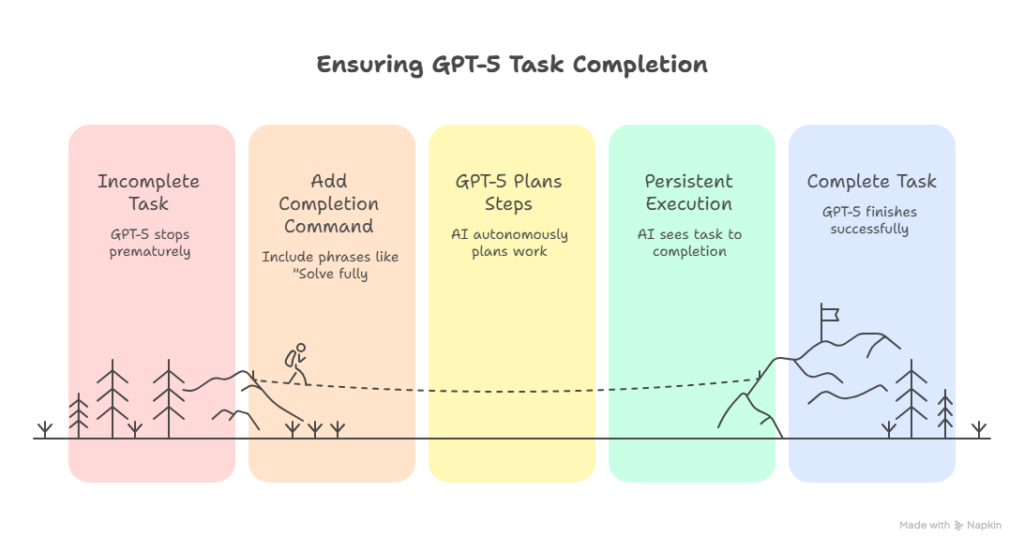
Example: “Write a blog post about the new marketing campaign. Submit it in a complete form including an introduction, body, and conclusion, and do not stop in the middle.”
3. Present a Systematic ‘Step-by-Step Plan’
Just as we work more efficiently with a plan, GPT-5 works more systematically when you provide it with the overall picture and its current position in the task.
Try providing the information in the order of: ‘Final Goal -> Overall Plan -> Current Status’. GPT-5 will accurately grasp the context and continue the task from the next step you need.

Example:
- Goal: Write a 5-minute speech script for a new product launch.
- Plan: 1. Define key product features. 2. Analyze the target audience. 3. Draft presentation slides. 4. Write the speech script.
- Current Status: Steps 1 and 2 are complete.
- Prompt: “Following the plan above, please start working from step 3, ‘Draft presentation slides’.”
4. Be Short and Clear, Not Long and Vague
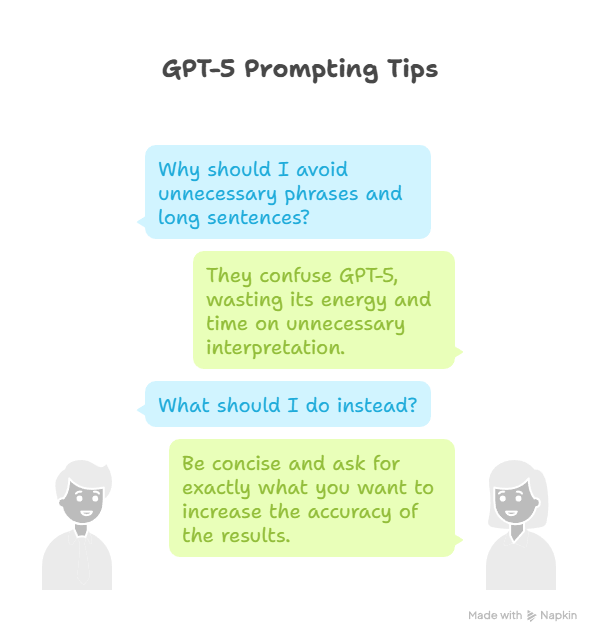
Unnecessary phrases like “If you could possibly…” or “If you’re not too busy…” and long, ambiguous sentences can confuse GPT-5. The model wastes energy and time on unnecessary interpretation.
Be concise and ask for exactly what you want. This will increase the accuracy of the results.
Example:
- Incorrect: “If it’s not too much trouble, could you possibly write a piece on this topic that’s not too long, maybe something one could read in about 3 minutes, but also make sure the content is substantial?”
- Correct: “Write a short article on this topic that takes 3 minutes to read.”
5. Assign a Clear ‘Role, Goal, and Format’
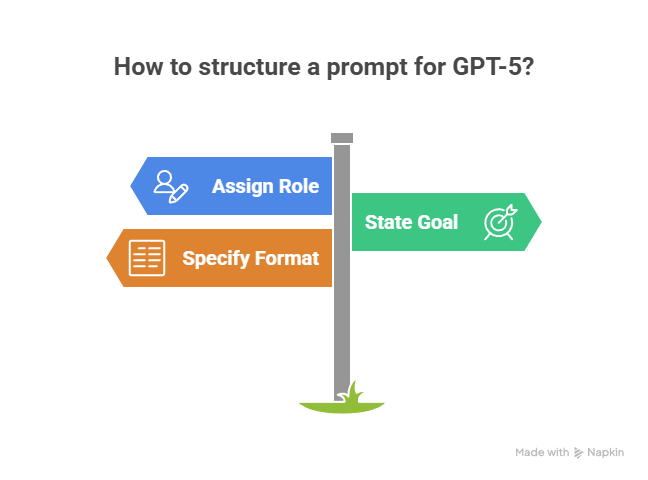
This is the most certain way to get the best results. Be specific by telling GPT-5 what role it should play, what it needs to do (the goal), and in what form the output should be.
- Role: Assigning a specific role (e.g., “marketing expert,” “travel writer”) makes the AI respond with the appropriate tone and perspective.
- Goal: Clearly state the task you want it to accomplish.
- Format: Specify the desired structure of the output, such as a report, email, table, or code, and it will be created accordingly.
- Example: “You are now a professional travel blogger. Your task is to summarize 5 travel tips for Paris for first-time visitors. The output must be in a table format.”
Conclusion
We are moving past the era of simply asking AI for information and into an era of creating new value together with AI.
Use the five strategies introduced today to professionally develop your ideas and create results that are beyond your imagination.