
A free AI detector can tell you “Your Text is AI/GPT Generated,” which is what ZeroGPT’s result screen said about the Gettysburg Address. To see how far to trust that, I tested human texts nobody could accuse of being ChatGPT, plus two essays AI really did write.
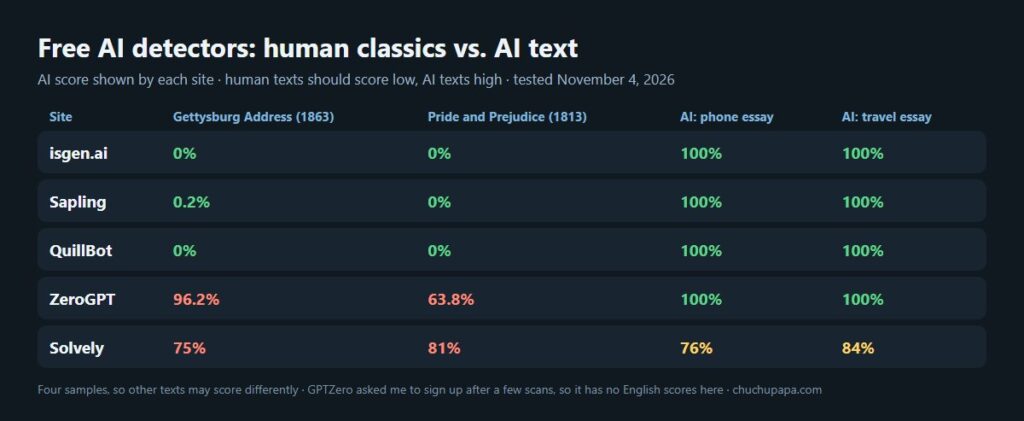
The same four texts went through five free sites. isgen.ai, Sapling and QuillBot got all four right. ZeroGPT scored the Gettysburg Address 96.2% AI, and Solvely put every text between 75% and 84%.
How I tested each free AI detector
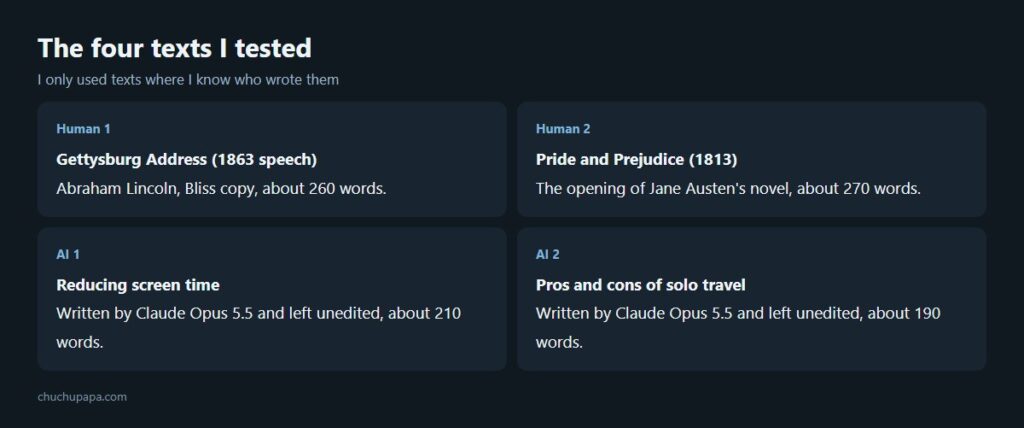
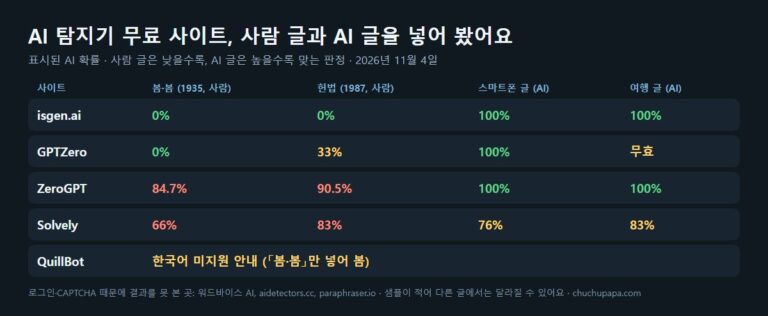
The human samples are the Bliss copy of the Gettysburg Address (one of Lincoln’s handwritten versions of the 1863 speech) and the start of Pride and Prejudice (1813), both from public-domain sources. The AI samples are two short essays, on reducing screen time and on solo travel, that I had Claude Opus 5.5 write and left unedited. I also ran four Korean samples (a 1935 novel, the Korean constitution and two AI essays), which are covered in the Korean version of this test.
I pasted each text into each site and recorded the AI score on screen. Each ran once, except that I repeated the Gettysburg Address on ZeroGPT and isgen.ai and got the same numbers. Four samples is a small test, so other writing could score differently. All the AI text came from one model, and the human texts are old and famous. I didn’t test recent human writing or AI text edited by a person. Wordvice AI, aidetectors.cc and paraphraser.io have no results here, because the Korean pages I tried wanted a login or a CAPTCHA first.
| Site | Gettysburg | Pride and Prejudice | AI: screen time | AI: travel |
|---|---|---|---|---|
| isgen.ai | 0% | 0% | 100% | 100% |
| Sapling | 0.2% | 0% | 100% | 100% |
| QuillBot | 0% | 0% | 100% | 100% |
| ZeroGPT | 96.2% | 63.8% | 100% | 100% |
| Solvely | 75% | 81% | 76% | 84% |
ZeroGPT: flagged Abraham Lincoln
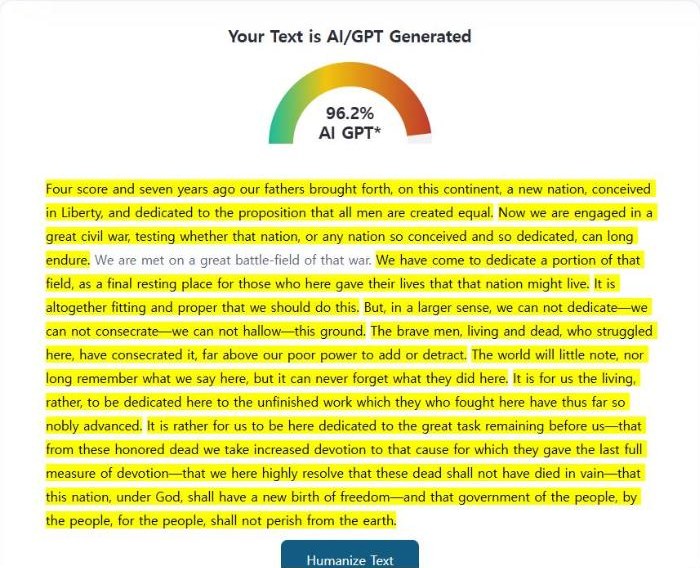
ZeroGPT takes up to 15,000 characters with no sign-up. It caught both AI essays at 100%, but it called the Gettysburg Address 96.2% AI and Pride and Prejudice 63.8%. In my Korean test, it gave a 1935 novel 84.7% and the Korean constitution 90.5%.
Its page lists 98.4% detection accuracy and a false positive rate (human writing wrongly flagged as AI) under 1%. Four human texts can’t measure a real error rate, but all four came back as mostly AI here. A “Humanize Text” button sits under the result.
Solvely: human and AI texts scored about the same
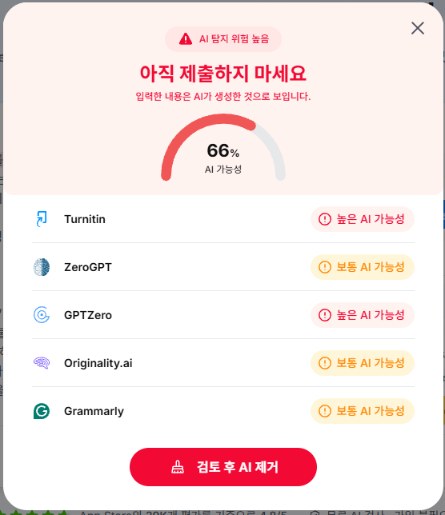
Solvely sent my browser to its Korean page, so that’s the interface I saw. That page promises no sign-up and no usage limit, while its English page mentions daily limits for free users. It never blocked me during this test. The English samples scored 75% to 84%, all labeled high AI likelihood. Pride and Prejudice (81%) scored higher than the screen-time essay AI wrote (76%), so in this test it didn’t separate the two groups.
On the 1935 Korean novel from my Korean test, a pop-up told me not to submit yet and offered to remove AI, followed by a second prompt to humanize the whole text. Solvely’s FAQ says free users get results from the ZeroGPT engine, but the ZeroGPT figure in its report was 65% on the novel, against 84.7% on ZeroGPT’s own site. I don’t know why they differ. The same FAQ says false positives can happen and that results are for reference, so if you wrote the text yourself, a warning like that isn’t a reason to rewrite it.
isgen.ai: right on every sample
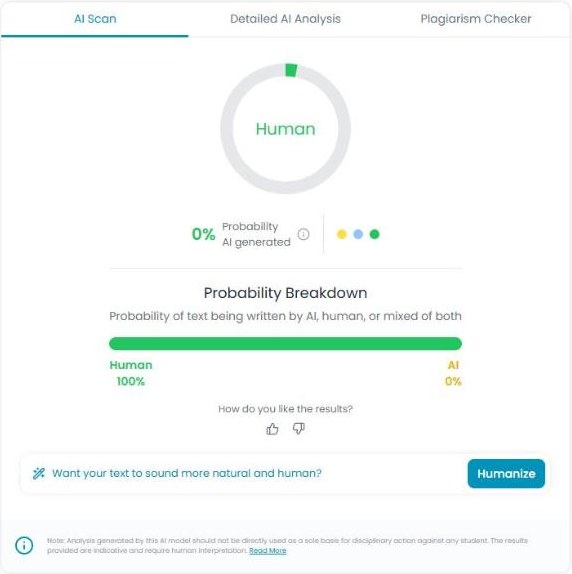
isgen.ai needs no account, takes up to 5,000 characters and lets you pick a language. All four English samples were correct, and so were all four Korean ones. It was the only site that got all eight of my samples right, but I didn’t run Korean on Sapling, and QuillBot declined it, so that isn’t a fair ranking. Its FAQ claims 96.4% accuracy on a benchmark, which my samples can’t confirm. It also admits false positives can happen, and the result screen warns against using the score as the only basis for disciplinary action.
Sapling: clear about its limits
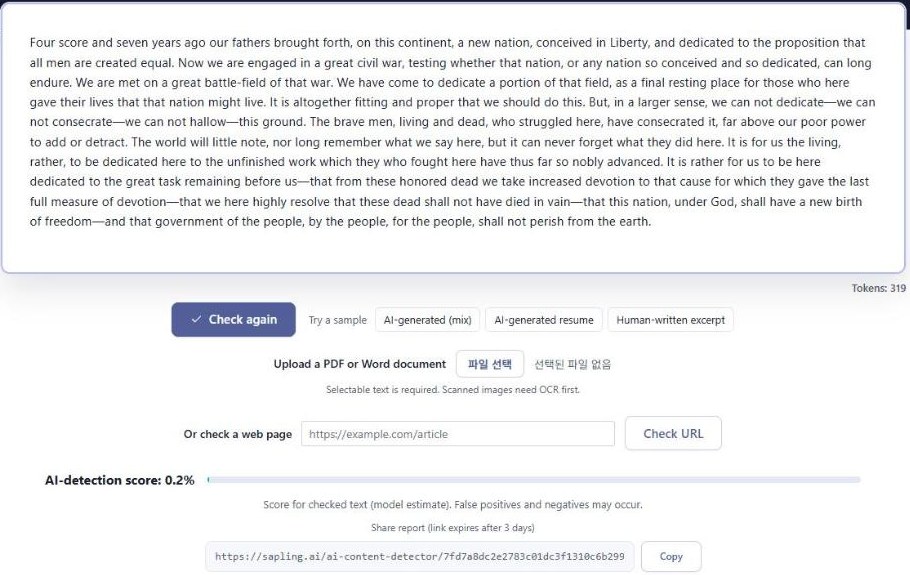
Sapling also works without an account, but the free version only checks the first 2,000 characters (all my samples were shorter). It scored the two human texts 0.2% and 0% and both AI essays 100%. Its page says no current detector, Sapling’s included, is enough on its own to decide whether text is AI. Korean isn’t on its list of supported languages, which includes English, Spanish, Portuguese, French, German, Italian, Dutch and Japanese.
QuillBot: right on all four, with a daily limit
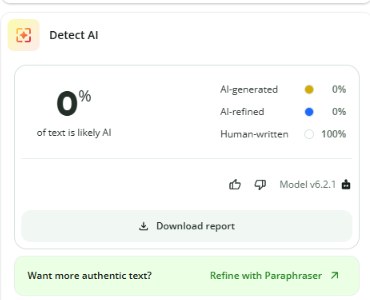
QuillBot got all four right, with 0% on the human texts and 100% on the AI essays. It needs at least 40 words and showed a daily allowance: “You’ve got 5 AI scans left today” before I began, and 1 after four scans. When I pasted the Korean novel, it gave no score and said the language isn’t supported yet, so you at least know where you stand.
GPTZero: asked me to sign up after a few scans
I couldn’t get English scores from GPTZero. I used its first scans on Korean samples, and it soon asked me to sign up. Be careful at that point: an “AI 100%” result stayed on screen after I pasted the Gettysburg Address, and only a small “Text changed” note showed that it wasn’t a new score. If a sign-up window appears, ignore the number behind it.
How to read a free AI detector score
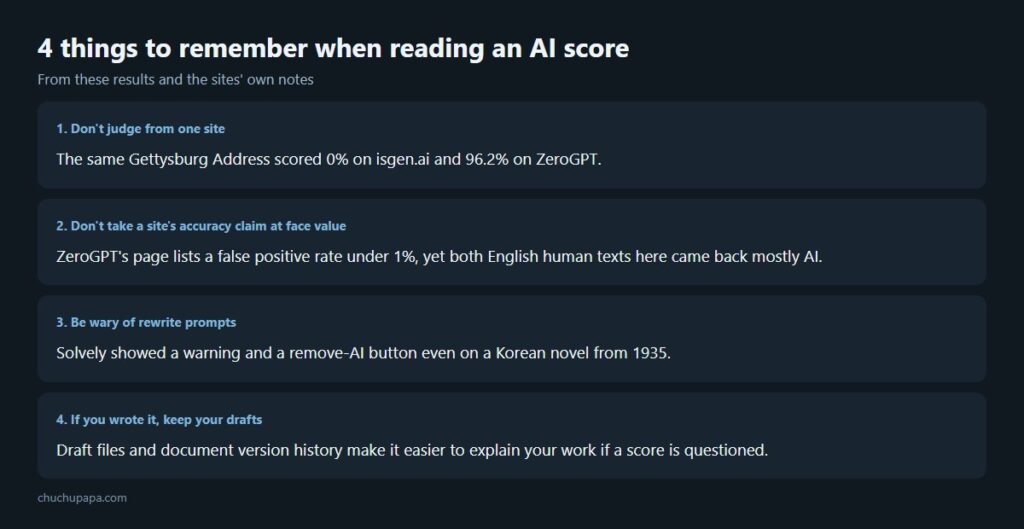
- Don’t judge from one site. The same speech scored 0% on isgen.ai and 96.2% on ZeroGPT.
- Don’t take accuracy claims at face value. ZeroGPT lists a false positive rate under 1%, yet both English human texts came back mostly AI.
- Be wary of rewrite prompts. ZeroGPT, Solvely, isgen.ai and QuillBot all showed a rewrite or humanize prompt next to results, including on human writing. Solvely’s was the most forceful.
- If you wrote it, keep your drafts. Draft files and version history make it easier to explain your work if a score is questioned.
I didn’t review these sites’ privacy terms, so check them before pasting anything sensitive.
Which free AI detector should you use?
In this test, isgen.ai, Sapling and QuillBot were correct on all four English samples, so I’d start with one of those. Remember that I didn’t test recent human writing, so a clean result on Lincoln says little about a student essay. I wouldn’t conclude that someone used AI from a high score on any one site, especially since ZeroGPT and Solvely flagged writing more than 150 years old.
A score is an estimate, not proof. If two sites disagree, ask for drafts or version history, or ask the writer to explain how they wrote it. I tested free OCR sites the same hands-on way.